The Art of Waiting: How Union Station Transforms Transit Delays Into Architectural Discovery

There is a particular frustration that belongs exclusively to the traveler: the announcement of a delay. The departure board updates, the minutes stretch, and the carefully arranged schedule collapses into open, unstructured time. At most transportation hubs, this is simply a grievance to be endured. At Washington, D.C.'s Union Station, it is something else entirely—an unexpected invitation.
Few public buildings in the United States were designed with as much deliberate attention to the experience of the stationary visitor as Union Station. Completed in 1907 under the direction of architect Daniel Burnham, the station was conceived not merely as a machine for transit but as a civic monument—a place where the act of being present carried its own reward. That intention, embedded in stone and proportion more than a century ago, continues to operate on visitors today, often without their awareness.
A Space That Rewards the Unhurried Eye
The Main Hall—what many visitors instinctively call the rotunda—measures 96 feet from floor to ceiling at its highest point. That figure is easy to cite and difficult to truly absorb. The scale does not announce itself immediately. It accumulates. A traveler who arrives in motion, rolling luggage across the Tennessee coquina marble floor, may register the room as impressive in a general sense. The traveler who is compelled to sit, however, begins to see it differently.
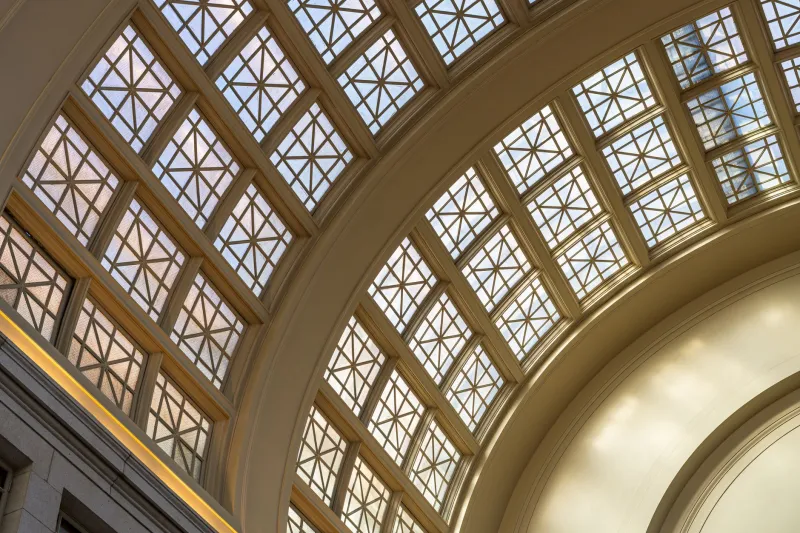
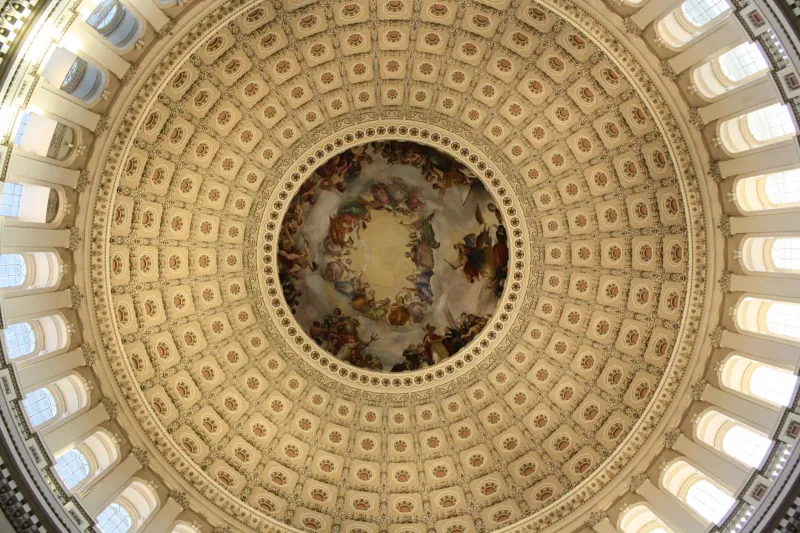
The coffered barrel-vault ceiling, gilded and compartmentalized into panels of painstaking detail, becomes legible only over time. The 36 figures positioned along the upper balustrade—Roman legionaries standing in silent procession—reveal themselves gradually, one by one, as the eye learns where to look. The decorative scheme does not offer itself all at once. It unfolds, and the unfolding requires patience that most travelers, under ordinary circumstances, would not willingly supply.
A delay supplies it for them.
The Logic of Sight Lines
Burnham and his collaborators did not design Union Station's interior as a passive backdrop. The spatial arrangement reflects a studied understanding of how human beings move through and perceive large rooms. The long axis of the Main Hall draws the eye toward the arched windows at the far end, where light enters in measured quantities throughout the day, shifting in color and intensity from morning to late afternoon. This is not accidental. The orientation of the building was chosen in part to manage that light—to ensure that the interior remained animated by natural illumination rather than rendered static by it.
Seating in the Main Hall, while practical in function, also anchors the visitor within the composition. Positioned beneath the central vault, a seated traveler occupies what might be described as the optimal vantage point—close enough to the decorative surfaces to read their detail, far enough from the walls to appreciate the full sweep of the arches above. It is, in architectural terms, the position from which the room makes the most complete sense.
This is the quiet genius of the design: the building performs differently depending on whether you are moving through it or resting within it. The rushed traveler receives a strong impression of grandeur. The waiting traveler receives an education.
Details That Surface Only in Stillness
Consider the station's ornamentation at close range. The decorative plasterwork that borders the arches and frames the lunette windows above the main entrances contains motifs drawn from classical antiquity—laurel wreaths, acanthus scrolls, and rosette patterns executed with a precision that speaks to the ambitions of the craftsmen who installed them. These elements are not visible from a distance in any meaningful way. They reward proximity and attention.
Similarly, the pink granite columns that line the east and west ends of the hall carry a subtle variation in their veining—no two columns are identical. This is a characteristic of natural stone that the design embraces rather than conceals. The columns were selected and positioned so that the overall visual effect reads as harmonious, but the individual surfaces repay close inspection with evidence of their geological individuality.
A traveler with forty minutes to spare and a willingness to move slowly through the space will encounter these details as a series of small discoveries. The experience bears less resemblance to sightseeing than to reading—a process of accumulating meaning through sustained attention.
The Station as a Counterweight to Urgency
There is a cultural dimension to this that extends beyond architecture. American travel culture is, by disposition, oriented toward efficiency. The ideal journey is the one that proceeds without interruption, without excess time, without unscheduled pauses. Delays register as failures of the system.
Union Station gently resists this framing. The building's scale and its materials—marble, granite, gilded plaster—belong to a tradition of civic construction that regarded permanence and gravity as virtues. These are not the materials of a facility designed to process passengers as rapidly as possible. They are the materials of a building that expects to be inhabited, to be looked at, to be considered.
In this sense, the station functions as a counterweight to the urgency that surrounds it. Amtrak trains arrive and depart. The Metro below carries commuters in efficient silence. The retail concourses hum with ordinary commerce. And at the center of all of it, the Main Hall maintains its measured, unhurried character—a space that has been absorbing the restlessness of American travelers for over a century and, in doing so, offering them something they did not know they needed.
Finding the Invitation in the Inconvenience
For the visitor who finds themselves with unplanned time at Union Station, the building itself offers a structured response to the formlessness of waiting. Begin at the central floor of the Main Hall and look upward. Allow the ceiling to take its time registering. Then move toward the walls and examine the bas-relief ornamentation at eye level. Walk the length of the hall at a pace that permits the proportions to shift as you move. Step toward the arched windows and observe how the light has changed since you arrived.
These are not the activities of a tourist following a checklist. They are the activities of a visitor who has accepted the station's implicit offer—to treat the time not as lost but as redirected.
Union Station was built at a moment when American civic ambition expressed itself through architecture of exceptional quality and scale. That ambition has not diminished with age. If anything, the passage of time has deepened the building's capacity to reward attention, as the layers of history and craftsmanship accumulate meaning that no single visit can fully exhaust.
The departure board will update again. The train will arrive. But for the traveler willing to receive what the station offers in the interval, the delay will have been, in its own quiet way, the most memorable part of the journey.