Architecture in Echo: The Deliberate Acoustic Design That Made Union Station's Rotunda Sing

When Daniel Burnham drafted his vision for Washington, D.C.'s Union Station in the early twentieth century, he was working within a tradition that regarded public architecture as a form of civic theater. Every surface, every proportion, every material choice was expected to communicate something — not only to the eye, but, as it turns out, to the ear. The result, completed in 1908, was a building that did not merely shelter the traveler. It spoke to them.
For the millions of Americans who have passed through Union Station's Main Hall and beneath the magnificent coffered ceiling of its rotunda, the experience of sound in that space has always been something slightly apart from the ordinary. Voices carry in unexpected ways. The rumble of arriving trains, once conducted through the building's structure, arrived as a kind of low ceremonial vibration before the train itself came into view. And the ambient noise of a crowd — which in any lesser building becomes a shapeless roar — here acquires texture, almost rhythm. None of this happened by accident.
The Physics of a Vaulted Ceiling
The essential acoustic character of Union Station's principal spaces derives from the same geometric logic that makes a whispering gallery function. When sound waves strike a curved, hard surface — and Union Station's rotunda offers precisely that combination in abundance — they do not scatter randomly. Instead, they follow the contour of the vault, traveling along its interior curve and arriving at distant points with a clarity that seems to defy the distance traveled.
Burnham and his collaborators, working within the Beaux-Arts tradition, were drawing on centuries of accumulated architectural knowledge about enclosed monumental spaces. The Roman Pantheon, the great European railway termini, the domed reading rooms of national libraries — each of these precedents had demonstrated that enclosure at a certain scale, executed in certain materials, produces an acoustic environment that feels qualitatively different from the everyday. Sound, in such spaces, acquires weight and presence.
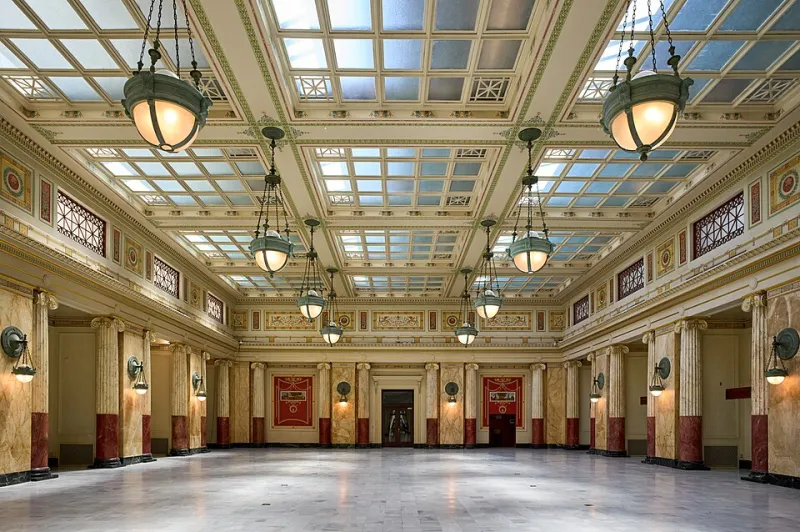
At Union Station, the primary hall rises to a coffered barrel vault approximately ninety-six feet above the floor. That height, combined with the hall's length and the reflective hardness of its surfaces, creates what acousticians refer to as a long reverberation time — the interval during which sound continues to decay after its source has ceased. In practical terms, this means that a spoken sentence does not end cleanly. It lingers, overlapping with what follows, lending even ordinary conversation a subtle resonance that passengers have described, across generations, as the station seeming to listen.
Announcements as Architecture
For much of the twentieth century, Union Station's primary medium of mass communication with its passengers was the human voice amplified through a public address system. Train callers — the men and women tasked with announcing departures and arrivals — were a recognized professional class, selected in part for voices that would carry effectively in large enclosed spaces. At Union Station, the rotunda's acoustics meant that a skilled caller's announcement did not merely inform; it filled the room.
Passengers who traveled through the station during its mid-century peak have described the experience of hearing a departure called as something close to theatrical. The caller's voice, launched into the vaulted space, would reach the far end of the hall slightly after it left the near end, creating a natural, if faint, doubling effect. The announcement seemed, in some accounts, to arrive from the building itself rather than from any particular human source — as though the station were confirming the departure on its own authority.
This phenomenon was not incidental to the station's emotional power. The announcement of a train's departure, in a space that amplified and prolonged the sound, became a kind of formal punctuation to a journey's beginning. The acoustic environment participated in the ritual of travel.
Whispered Goodbyes and the Intimacy of Echoes
The rotunda's acoustic properties operated at the opposite end of the volume spectrum as well. Because sound travels efficiently along curved surfaces, two people standing at opposite ends of the hall's curved wall could, under the right conditions, hear one another's whispered words with startling clarity — while a person standing midway between them might hear nothing at all. This architectural curiosity, common to whispering galleries the world over, has its own quiet history at Union Station.
Wartime departures in particular have entered the station's oral tradition as moments when the building's acoustics seemed to conspire with human emotion. A farewell spoken softly at one end of the hall, intended only for one pair of ears, might carry to another couple twenty feet away engaged in their own private moment — a reminder, inadvertent and intimate, that the station was a shared space for a common human experience. The architecture did not distinguish between the public and the personal. It amplified both equally.
Historic Speeches and the Weight of Resonance
Union Station has served on numerous occasions as a venue for public address, from presidential arrivals to ceremonial gatherings of national significance. The acoustic properties of the main hall have lent these occasions a particular gravity. A voice projected into that space does not simply travel outward from a speaker's mouth and dissipate. It accumulates, briefly, in the vault above — and then descends again, altered in quality, as if the building has processed the words and returned them with its own endorsement.
This quality was not lost on those who spoke in the station during its most historically charged moments. The sense that one's words were being received not merely by the assembled crowd but by the architecture itself — that the marble and the vaulted plaster were, in some sense, recording the occasion — added a dimension to public address in this space that few other American interiors could match.
A Living Acoustic Legacy
Union Station's restoration in the 1980s, which returned the main hall to something approaching its original grandeur after decades of deterioration, also restored its acoustic character. The removal of the dropped ceilings and partitions that had been introduced during the building's years of misuse allowed the vaults to function again as their designers intended — not only visually, but sonically.
Today's visitor who pauses in the main hall and listens carefully will still encounter the station's distinctive sound environment. The ambient noise of a busy travel hub — rolling luggage, conversations in a dozen languages, the distant announcement of departures — reaches the ear with a richness and complexity that no modern airport terminal, however efficiently designed, can replicate. The sound of Union Station is, in its own way, a form of architectural preservation: evidence that the building's original designers understood something fundamental about how human beings experience space, and built accordingly.
To stand in the rotunda and simply listen is to receive a transmission from 1908 — a reminder that Burnham and his collaborators were not only shaping what Americans would see when they entered this building, but what they would hear, and how, in that hearing, they would feel the particular weight of a journey about to begin.