Framed in Marble: Why Union Station's Rotunda Has Become a Magnet for Photographers, Filmmakers, and the Lens-Obsessed
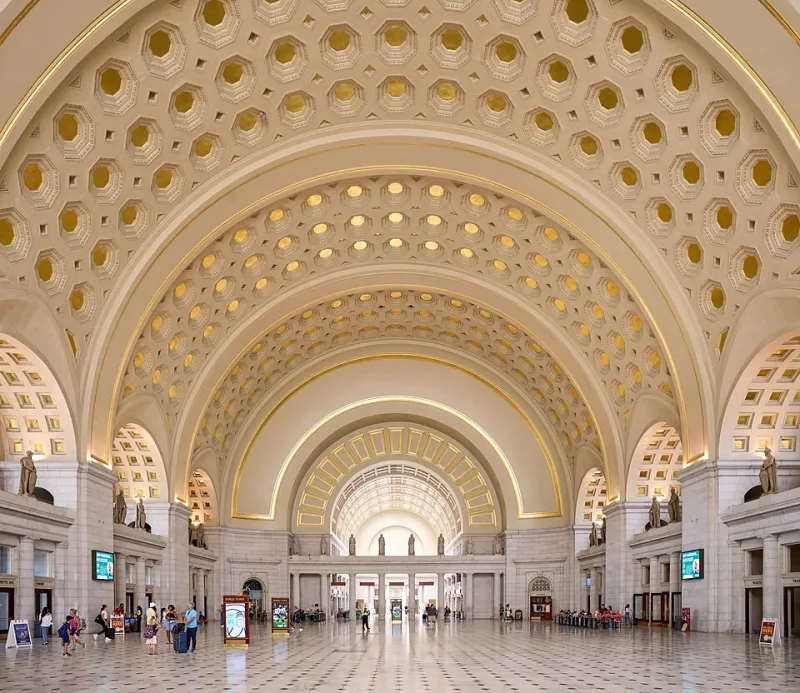
There is a moment that nearly every first-time visitor experiences upon entering Union Station's main hall. The threshold between the outside world and the interior is crossed, and the eye simply does not know where to settle. The barrel-vaulted ceiling rises nearly 96 feet overhead. Columns of Roman grandeur march in measured procession along both flanks. Light — soft, diffuse, and seemingly sourceless — descends from coffered windows and renders the white plaster in tones that shift by the hour. It is, in the most literal sense, a photographer's dilemma: there is too much to photograph, and yet every angle seems to compose itself.
This is not accidental. It is architecture doing precisely what it was designed to do.
The Geometry of Awe
When architect Daniel Burnham completed Union Station in 1907, he was working within the tradition of the City Beautiful movement, a philosophy that held civic architecture responsible for elevating the moral and aesthetic character of American life. The station was not merely a transit facility; it was a statement about what the United States capital deserved at the dawn of the twentieth century.
The rotunda's success as a photographic subject flows directly from the principles Burnham applied. Symmetry, above all else, dominates the space. The central axis of the main hall is so precisely balanced that a photograph taken from the midpoint of the entrance creates an almost mirror-image composition on either side. For a photographer, this symmetry functions as a built-in compositional rule — the space organizes itself.
The proportional relationship between floor, column, and ceiling is equally significant. Burnham derived his measurements loosely from the Baths of Diocletian in Rome, a structure whose dimensions were calculated to make the human figure feel simultaneously small and exalted. In practice, this means that any photograph including a person automatically gains a sense of scale and drama. The individual becomes a figure in a composition rather than simply a subject in a room.
Light as Architectural Material
No discussion of the rotunda's photographic appeal can proceed without addressing light. The station's designers treated illumination not as a utility but as a building material in its own right. The lunette windows positioned high along the hall's flanks allow natural light to enter at an oblique angle throughout most of the day, creating the kind of soft, directional illumination that portrait photographers spend considerable effort and expense attempting to replicate artificially.
In the early morning, this light rakes across the coffered ceiling and catches the relief work in sharp relief, producing shadows that emphasize the depth and texture of the plasterwork. By midday, the angle shifts, and the floor — polished and expansive — begins to reflect ambient light upward, filling the lower portions of the space with a warmth that photographers describe as almost cinematic. Late afternoon brings a cooler, more dramatic quality as the direct sunlight retreats and the hall settles into a dignified half-shadow.
These variations mean that the same location, visited at different hours, yields substantially different photographs. It is one of the reasons that dedicated photographers return repeatedly, and one of the reasons the station's interior has accumulated such a remarkable archive of images across social platforms.
Hollywood's Favorite Civic Interior
Union Station's screen history is long and distinguished. The station has served as a filming location since the mid-twentieth century, appearing in productions that range from political thrillers to romantic dramas. Its architecture offers filmmakers something that purpose-built sets rarely achieve: authentic scale. The ceiling height, the depth of the hall, and the weight of the stone columns are not illusions constructed from foam and paint. They are real, and cameras register that reality.
Filmmakers have used the space to suggest institutional power, historical gravitas, and the particular American mythology of arrival and departure. A character walking the length of the main hall toward the camera carries the full symbolic freight of the building's proportions. The journey across that floor, with columns receding on both sides and the ceiling arching overhead, communicates ambition, consequence, and movement in a way that a conventional interior simply cannot.
The station's appearance in television productions has introduced it to younger audiences who may encounter it first on screen and seek it out in person afterward — a reversal of the traditional relationship between place and representation.
The Social Media Dimension
The rise of image-sharing platforms has introduced an entirely new class of visitor to Union Station: the photographer who arrives not to travel but to photograph. Armed with smartphones and mirrorless cameras, these visitors seek out the angles that have circulated widely online — the long perspective shot down the central hall, the upward view into the coffered ceiling, the silhouette framed against a window arch.
What is notable about the station's social media presence is its consistency. Unlike many photogenic locations, where the most popular images tend to cluster around a single viewpoint, Union Station generates compelling photographs from multiple positions and orientations. The space is generous in its compositions. This generosity has contributed to a self-reinforcing cycle: more photographs produce wider awareness, which draws more photographers, who produce more photographs.
The station's management has, to its credit, maintained the integrity of the space even as its photographic popularity has grown. The main hall remains accessible to visitors who are not traveling, which preserves the democratic character of a building always intended to serve the public.
Why the Rotunda Endures
Architectural spaces that sustain lasting photographic interest tend to share certain qualities: genuine scale, authentic materials, and a design logic that rewards sustained attention. Union Station possesses all three. The more time one spends in the rotunda, the more its structure reveals itself — the relationship between the arcade arches and the clerestory windows above, the way the column capitals were carved with a specificity that suggests individual craftsmen rather than industrial production, the subtle curvature of the ceiling that prevents the space from feeling oppressive despite its height.
Photographers, whether professional or casual, are ultimately responding to design intelligence. They may not articulate it in those terms, but the impulse to raise a camera in this space is a form of recognition — an acknowledgment that something has been built here that exceeds the ordinary.
Union Station's rotunda was designed to impress, to endure, and to represent the aspirations of a young nation claiming its place among the world's great capitals. More than a century later, it continues to fulfill that mandate, one photograph at a time.