From Ruin to Renaissance: What Union Station's Restoration Taught America About Saving Its Greatest Buildings
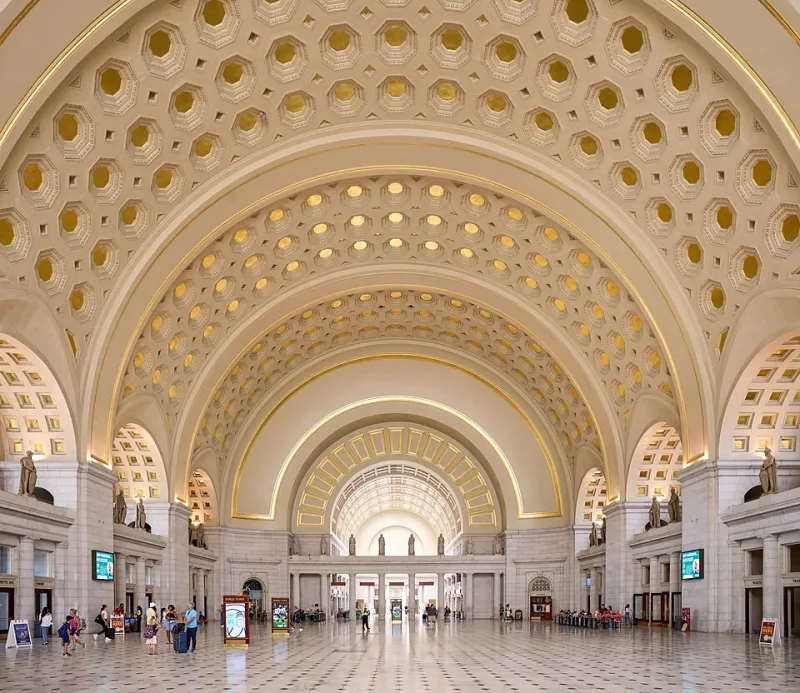
Photo: Frank Schulenburg, CC BY-SA 4.0, via Wikimedia Commons
There is a particular kind of grief that settles over a great building when it begins to fail. Ceilings buckle. Marble darkens with neglect. The grandeur that once announced the ambitions of a nation quietly recedes behind scaffolding, tarps, and bureaucratic indifference. By the 1970s, Washington D.C.'s Union Station had arrived at precisely that threshold. What happened next—the arguments, the money, the engineering, and ultimately the revival—became a defining chapter not only in the station's own history, but in the broader American conversation about what historic landmarks are worth saving and how, exactly, that saving gets done.
A Monument on the Edge
Designed by Daniel Burnham and opened in 1907, Union Station was conceived as a civic statement as much as a transportation facility. Its Beaux-Arts facade, monumental barrel-vaulted ceilings, and sweeping Main Hall were intended to project permanence. Yet by the mid-twentieth century, the station's fortunes had reversed dramatically. Declining rail ridership, deferred maintenance, and a disastrous 1976 conversion attempt—which briefly reimagined the building as a visitors' center for the American Bicentennial—left the structure in a state of genuine crisis. A section of the roof collapsed. Water infiltrated the foundations. The building that had once welcomed presidents was, by some assessments, approaching the point of no return.
What made Union Station's situation particularly instructive for later preservationists was that its deterioration was not merely physical. The station suffered from an identity crisis that compounded every structural problem. Without a clear purpose, funding mechanisms remained elusive, and without funding, repairs could not proceed. The lesson embedded in this period—that a building's programmatic future must be resolved before its physical restoration can succeed—would prove foundational to preservation thinking nationwide.
The Legislative and Financial Architecture of Recovery
The passage of the Union Station Redevelopment Act in 1981 marked a turning point, establishing a public-private partnership framework that would become a model for subsequent preservation efforts across the country. The legislation created a mechanism by which federal investment could be leveraged alongside private commercial development, distributing both the financial risk and the long-term stewardship responsibilities across multiple stakeholders.
This structure addressed one of the central dilemmas that had long paralyzed historic preservation: the tension between public ownership of culturally significant buildings and the practical need for private capital to fund their upkeep. Union Station's solution—granting long-term development rights to a private entity while maintaining federal oversight of the historic fabric—offered a template that has since influenced projects from Chicago's Union Station to Cincinnati's Music Hall.
The financing was not without friction. Negotiations over the commercial program, the scope of restoration work, and the allocation of costs stretched across years. Preservationists pushed back against proposals they feared would compromise the building's architectural integrity. Transportation planners demanded that the station's functional role be genuinely restored, not merely symbolic. The resulting compromise, which reopened the station in 1988, was imperfect by the admission of nearly everyone involved—but it was real, and it worked.
Engineering the Irreplaceable
The technical dimensions of the restoration presented challenges that no amount of legislative creativity could shortcut. The Main Hall's 96-foot coffered ceiling, the Ionic colonnades, the intricate plasterwork, and the Tennessee marble floors each required specialized expertise that had, in some cases, nearly vanished from the American construction trades.
Restoration teams faced decisions that preservationists still debate: when to repair original material, when to replicate it, and when to acknowledge that certain elements were simply beyond recovery. The guiding principle, drawn from the Secretary of the Interior's Standards for Rehabilitation, was to preserve as much original fabric as possible while ensuring the building's long-term viability. In practice, this meant painstaking work—matching historic mortar formulations, sourcing stone from the original quarries where possible, and training craftspeople in techniques that had not been widely practiced for decades.
The engineering challenges extended below the visible surface. Structural repairs to the foundations, remediation of water infiltration, and the integration of modern building systems—electrical, mechanical, life safety—into a century-old structure demanded solutions that could not compromise the historic envelope. The methods developed during Union Station's restoration have since been cited in technical guidance documents used by preservation professionals working on comparable projects.
The Blueprint in Practice
The preservation community's interest in Union Station's story extends well beyond Washington. As Beaux-Arts and Gilded Age structures across the United States face similar pressures—aging infrastructure, changing transportation patterns, and the chronic difficulty of securing adequate funding—the station's experience offers a series of lessons that translate across geography and building type.
Chief among them is the importance of adaptive reuse as a preservation strategy. A building that generates revenue is a building that can sustain its own upkeep; one that does not becomes dependent on the goodwill of public budgets that rarely prioritize historic structures. Union Station demonstrated that Beaux-Arts grandeur and contemporary commercial activity are not inherently incompatible—that, in fact, each can reinforce the other when the balance is managed with discipline.
Equally significant is the role of community and civic identity in sustaining preservation momentum. Union Station's revival was not driven solely by architecture enthusiasts or transportation advocates. It drew support from a broad coalition of Washingtonians who understood the station as a piece of their city's identity—something worth fighting for because it represented something larger than itself. Preservation efforts that lack this civic dimension, practitioners have observed, tend to stall when funding becomes difficult or political priorities shift.
A Living Landmark
Today, Union Station serves more than 40 million visitors annually, functioning simultaneously as an active transportation hub, a commercial destination, and one of the most visited historic landmarks in the United States. The restoration has not been without its ongoing challenges—the building continues to require significant investment, and debates about its future programming remain active. But the fundamental achievement stands: a structure that was within a decade of potential demolition has been returned to the center of Washington's public life.
For visitors who walk through the Main Hall today, the scale and beauty of the space carry a weight that goes beyond aesthetics. What surrounds them is not merely a restored building but the product of a sustained, sometimes contentious, ultimately successful argument about what American landmarks are worth preserving—and what it takes to actually do it.