Witness in Marble: The Defining American Moments That Unfolded Beneath Union Station's Vaulted Ceilings
Photo: Frank Schulenburg, CC BY-SA 4.0, via Wikimedia Commons
There is a particular quality to spaces that have endured long enough to absorb history. Union Station in Washington, D.C., opened its doors in 1907, and in the decades that followed, its Beaux-Arts interior became something no architect had explicitly designed it to be: a stage for the American story. Presidents passed through its gates. Soldiers said their final goodbyes beneath its coffered ceilings. Protesters raised their voices where travelers once rushed to catch trains. The building did not merely witness these events—it shaped them, lending its grandeur to moments that might otherwise have felt smaller, more provisional, less permanent.
What follows is not a comprehensive chronicle. It is, rather, a series of windows into the past, each one revealing a different facet of what this station has meant to the nation it serves.
The Weight of War: Departures That Defined a Generation
During both World War I and World War II, Union Station functioned as one of the most emotionally charged spaces in the country. Troop trains departed from its platforms around the clock, and the Rotunda itself became an informal gathering point for families who had traveled to Washington specifically to see their sons, husbands, and brothers off to service.
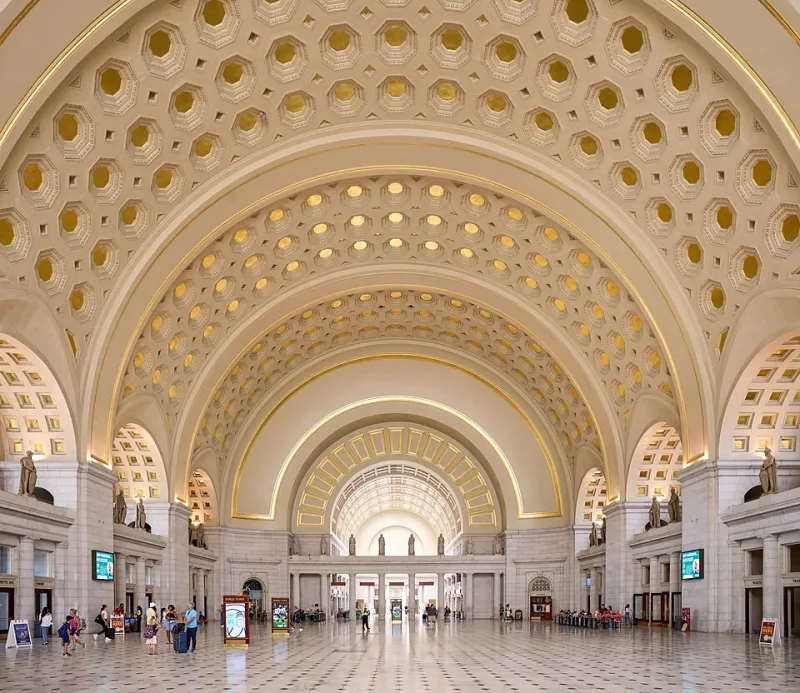
The Red Cross maintained a prominent canteen operation within the station during World War II, serving millions of meals to soldiers in transit between 1941 and 1945. Volunteers—many of them prominent Washington socialites—worked alongside everyday citizens to ensure that no serviceman passed through hungry or unacknowledged. Contemporary accounts describe the Great Hall during these years as a place of almost unbearable emotional intensity: tears and laughter mingling beneath the 96-foot barrel-vaulted ceiling, the smell of coffee and cigarette smoke drifting through the waiting room, and the constant percussion of departure announcements echoing off the stone floors.
For countless American families, Union Station was the last place they ever saw someone they loved. That grief is woven into its walls as surely as the limestone itself.
A President's Final Journey
Perhaps no single event more powerfully illustrates Union Station's role as a national gathering place than the return of President Franklin D. Roosevelt's body to Washington following his death in Warm Springs, Georgia, in April 1945. The funeral train arrived at Union Station on April 14th, and the station was transformed overnight into a site of collective mourning.
Thousands of Washingtonians lined the route from the station to the White House, and many gathered inside the terminal itself, unable or unwilling to wait at home for news. The station's scale—which can feel overwhelming in ordinary times—seemed, on that occasion, to provide something essential: a space large enough to contain national grief, a room whose proportions matched the magnitude of what the country had lost. Eyewitness accounts from the time consistently describe the crowd inside the terminal as unusually quiet, the typical noise of a busy station replaced by something closer to reverence.
It was not the first or last time that Union Station would serve as a site of national mourning. The body of Senator Robert F. Kennedy passed through its gates in June 1968, following his assassination in Los Angeles, as mourners lined the tracks for hundreds of miles along the route from New York.
The Civil Rights Era and the Station's Complicated Role
Union Station's history is not without its contradictions. For much of its early history, the station maintained segregated facilities—a fact that sits uneasily alongside its reputation as a democratic public space. African American travelers were directed to separate waiting rooms and dining facilities, a practice that persisted well into the mid-twentieth century and that civil rights advocates challenged repeatedly.
The station's proximity to the National Mall made it a natural point of convergence for the major demonstrations of the civil rights era. Participants in the 1963 March on Washington arrived at Union Station by the tens of thousands, streaming through its doors and onto the streets leading toward the Lincoln Memorial. For many who had traveled from the Deep South, the station represented their first encounter with the capital—a moment of arrival that carried symbolic weight far beyond the merely logistical.
The desegregation of Union Station's facilities in the years following World War II was itself a small but meaningful chapter in the broader story of American civil rights, one that played out in the same public rooms where so many other dramas had unfolded.
Celebrity, Culture, and the Theater of Arrival
Not every defining moment at Union Station has carried the gravity of war or political struggle. For much of the twentieth century, the station also served as Washington's premier stage for a different kind of American spectacle: the celebrity arrival.
In an era before air travel became the default mode of long-distance transportation, arriving by train at Union Station meant arriving in public, in a space designed to amplify the drama of arrival. Dignitaries, film stars, and heads of state all passed through the same marble halls, and the station's press corps—ever-present, ever-alert—ensured that these moments were documented and disseminated to a fascinated public.
The station's design contributed directly to this theatrical quality. The long approach through the Main Hall, the soaring scale of the Rotunda, the measured procession toward the exits—all of it created a natural choreography of arrival that no airport terminal has ever quite replicated. To arrive at Union Station was to make an entrance.
History Still in the Making
What is remarkable about Union Station is not simply that history happened here—history happens everywhere. What distinguishes this building is its capacity to elevate the moments it contains, to lend them a weight and permanence that ordinary spaces cannot provide. The 96-foot ceiling does not merely shelter visitors; it amplifies them. The marble floors do not merely support foot traffic; they record it.
Visitors who pass through the Rotunda today are, whether they realize it or not, walking through a century of American life. The building has survived financial ruin, physical neglect, and wholesale transformation. It has outlasted the political movements that gathered beneath its roof and the celebrities who posed for photographs in its halls. It remains, as it has always been, a place where the private and the public, the momentous and the mundane, converge in a space designed—whether by intention or by fortune—to make both feel equally significant.
The next time you find yourself standing in the Great Hall, pause for a moment before consulting your departure board. Look up. Consider what these walls have seen. Then proceed to your platform—because Union Station, as ever, is also simply a place where people catch trains.