When the Room Itself Speaks: The Acoustic Legacy of Union Station's Grand Rotunda
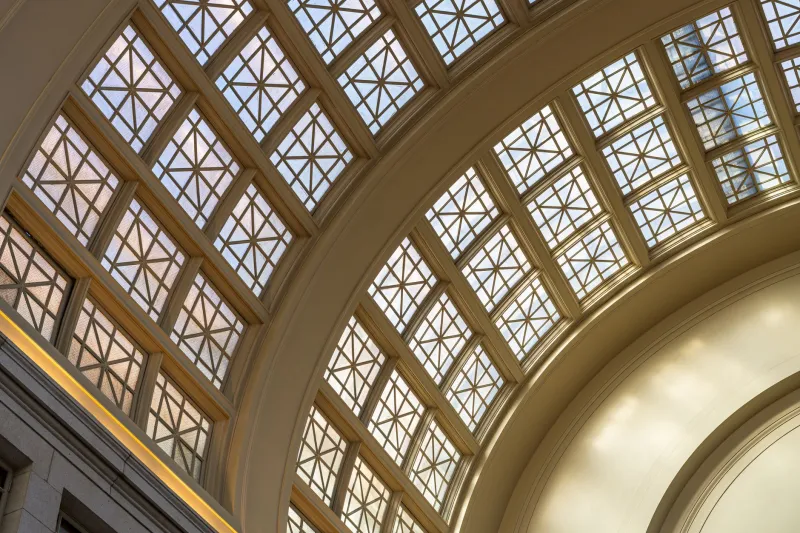
There is a particular moment that frequent visitors to Union Station tend to describe in strikingly similar terms. They step beneath the coffered barrel vault, pause somewhere near the center of the hall, and become aware — gradually, almost involuntarily — that the room is doing something to sound. A distant announcement sharpens into clarity. A child's laughter arrives from an unexpected direction. Two people whispering across a considerable distance discover, to their mutual surprise, that they can hear one another perfectly. The rotunda, it seems, has opinions about acoustics.
This phenomenon is not accidental, nor is it entirely the product of deliberate engineering. It is, rather, the consequence of a series of architectural decisions made in the early twentieth century that happened to produce one of the most distinctive sonic environments in the United States — a space that has influenced how Americans experience public gathering, political speech, and the emotional texture of departure and return.
The Physics Beneath the Plaster
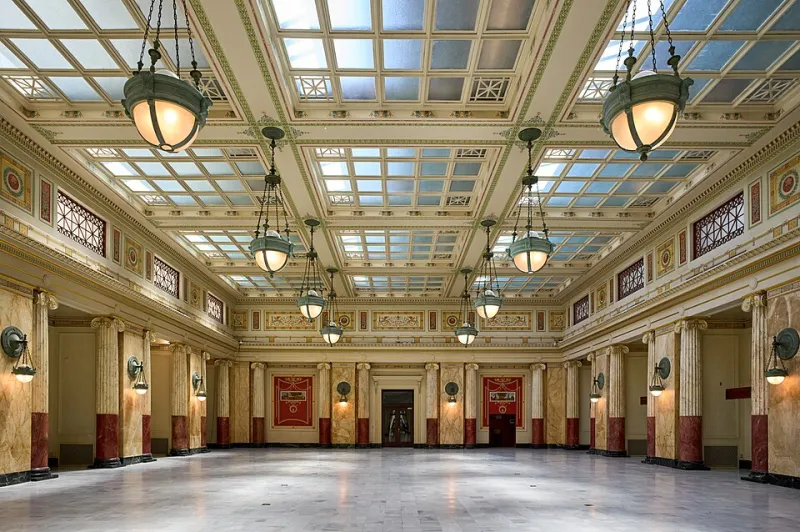
To understand what Union Station's rotunda does to sound, it helps to consider what the room actually is from a physical standpoint. The main waiting hall — often referred to colloquially as the rotunda, though its geometry is closer to a vast barrel-vaulted nave — stretches approximately 220 feet in length and rises to a coffered ceiling that clears 96 feet at its apex. The walls are faced with white marble and plaster surfaces that possess very low absorption coefficients, meaning they reflect rather than consume acoustic energy.
When sound enters this environment, it does not simply travel outward and fade. Instead, it bounces. It accumulates. It layers. The technical term for the resulting phenomenon is reverberation — the persistence of sound after its source has ceased — and the rotunda generates a reverberation time that audio engineers estimate at somewhere between two and four seconds under typical conditions. For context, a well-designed concert hall targets a reverberation time of roughly two seconds. A dry recording studio aims for something close to zero. Union Station's main hall exists in a register that belongs, acoustically speaking, to cathedrals and grand civic chambers.
The coffered ceiling amplifies this effect in a specific way. Each recessed panel acts as a shallow resonating cavity, capturing certain frequencies and returning them to the room with added emphasis. The result is a tonal coloration — a subtle warmth and fullness — that transforms even mundane sounds into something more resonant, more present, more significant.
A Stage Built for Human Drama
The practical consequences of this acoustic environment have played out across more than a century of American history. During both World Wars, the rotunda served as a primary point of departure for millions of servicemen and women, their families pressing close in scenes of farewell that the room's natural amplification rendered almost unbearably vivid. Historians who have studied firsthand accounts from those periods note with some consistency that witnesses described the emotional intensity of the space in terms that were partly sonic — the collective murmur of a crowd, the echo of a final goodbye, the way a single voice calling a name could carry across the entire hall.
Politicians recognized the room's oratorical potential early. The rotunda's ability to carry a speaker's voice without electronic assistance made it a favored venue for public addresses at a time when microphones were unreliable and public address systems were primitive. A speaker positioned near the center of the hall, projecting toward the arched windows at the far end, could address a crowd of thousands with a clarity that indoor spaces of comparable size rarely permitted. This was not incidental to the political life of Washington, D.C. — it was architectural infrastructure for democracy.
Musicians, Engineers, and the Study of Unintended Perfection
In more recent decades, Union Station's acoustic properties have attracted a different kind of attention. Audio engineers studying the relationship between architectural form and sonic character have returned repeatedly to the rotunda as a case study in what might be called productive accident — the phenomenon by which a space designed for one purpose produces unexpected excellence in another.
Daniel Burnham, the architect who designed Union Station and oversaw its completion in 1908, was primarily concerned with movement, dignity, and the projection of civic authority. He drew heavily on the precedent of ancient Roman bath complexes, particularly the Baths of Diocletian, whose vast vaulted halls suggested a model for organizing large numbers of people with both efficiency and grandeur. Acoustic performance was not, by any available account, a primary design criterion. And yet the Roman precedent Burnham adopted had itself been refined over centuries in ways that happened to favor sound — the same proportions, the same reflective materials, the same geometric relationships between floor area and ceiling height that made Roman public spaces feel alive with human presence.
Musicians who have performed in the rotunda — whether in formal concerts organized by the station's management or in the informal busking sessions that have long been a feature of its daily life — describe the experience in terms that emphasize collaboration between performer and space. The room, they say, gives back. It sustains notes past their natural decay. It blends voices and instruments into a collective resonance that no single performer could produce alone. Several recording artists have sought permission to capture ambient recordings within the hall specifically to incorporate its natural reverb signature into studio productions, treating the room itself as an instrument.
Sound as Memory
Perhaps the most compelling dimension of the rotunda's acoustic legacy is the role it plays in personal memory. Neurological research has established that sound is among the most potent triggers of autobiographical recall — more reliable, in many instances, than visual cues. The particular sonic signature of Union Station's main hall, once experienced, tends to persist. Travelers who passed through the station decades ago and return today frequently report an immediate and powerful sense of recognition upon entering the rotunda, a feeling of having stepped not merely into a familiar building but into a familiar state of being.
This quality — the capacity of a space to embed itself in memory through sound — is rare in built environments. It requires a combination of scale, material, geometry, and use that few public spaces achieve. Union Station's rotunda achieves it, seemingly without having tried, and the result is a room that functions simultaneously as transportation hub, historical monument, and sonic landmark.
Listening to the Station
For visitors who wish to experience the rotunda's acoustic character deliberately rather than accidentally, a few simple practices are worth considering. Standing near the center of the hall and speaking softly reveals the room's tendency to gather and amplify; a voice that would disappear in an open outdoor space instead finds purchase against the vaulted ceiling and returns enriched. Arriving during the relative quiet of early morning — before the commercial activity of the station reaches full volume — allows the room's natural reverberation to become perceptible as a kind of presence, a low atmospheric hum that seems to belong to the building itself rather than to any identifiable source.
The station's grand hall has been called many things over its long history: a gateway, a monument, a marketplace, a crossroads. It is all of these. But it is also, for those who pause long enough to listen, a room that speaks — carrying forward, in its reflective surfaces and soaring vault, the accumulated sound of more than a century of American life.