Designed for the Multitude: The Hidden Logic That Keeps Union Station Graceful Under Pressure
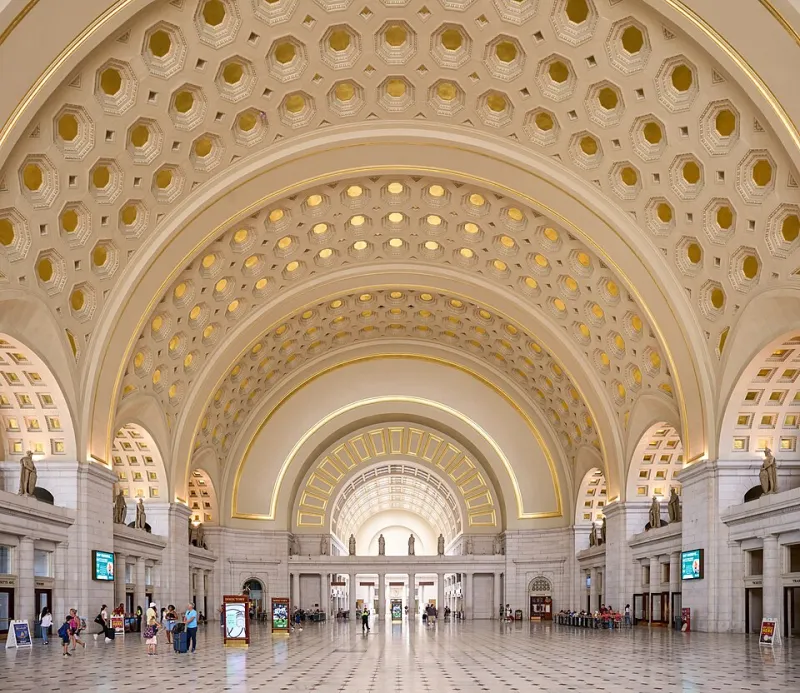
Photo: Frank Schulenburg, CC BY-SA 4.0, via Wikimedia Commons
On any given weekday morning, Union Station in Washington, D.C., receives a volume of foot traffic that would overwhelm most public buildings. Commuters, tourists, Amtrak passengers, Metro riders, and casual visitors converge on the same marble floors, moving in dozens of directions at once, consulting phones and departure boards, pausing for coffee, or simply cutting through on their way to the Capitol. By any reasonable measure, the place should feel chaotic.
It rarely does.
That composure—the sense that the building is somehow larger than the crowd it contains, no matter how dense that crowd becomes—is one of Union Station's most underappreciated qualities. It is also, as any architect or urban planner will tell you, one of its most deliberate achievements. Understanding how the station manages its daily multitudes is not merely an academic exercise. For the traveler, it is a practical guide to navigating one of America's great public spaces with confidence and pleasure.
The Rotunda as Pressure Valve
The first thing to understand about Union Station's crowd management is that it was never conceived as crowd management at all. When Daniel Burnham designed the station in the early 1900s, he was working within the Beaux-Arts tradition, which held that monumental civic architecture should communicate power, permanence, and civic aspiration. The vast scale of the Rotunda—96 feet from floor to ceiling, 760 feet in total length across the Main Hall—was intended to make visitors feel the weight of the American republic.
What Burnham could not have fully anticipated was how effectively that scale would function as a psychological buffer against congestion. Human perception of crowding is not simply a function of the number of people in a space; it is shaped by the ratio of people to available volume. In a room as tall and wide as Union Station's Great Hall, even substantial crowds register as manageable. The ceiling does not press down. The walls do not close in. Visitors unconsciously recalibrate their sense of personal space against the room's dimensions, and the result is a kind of psychological breathing room that no modern transit hub—however efficiently designed—has quite succeeded in replicating.
For the practical traveler, this means something specific: if the concourse feels overwhelming, the Rotunda rarely does. When the station is at its busiest, moving toward the center of the Main Hall rather than hugging the perimeter will almost always yield a calmer experience.
Sight Lines and the Architecture of Orientation
One of the subtler achievements of Union Station's design is the way it orients visitors without signage. The Main Hall's long axis draws the eye naturally toward the train concourse, while the symmetrical arrangement of the space—archways, columns, and decorative niches positioned at regular intervals—provides a set of visual anchors that allow visitors to locate themselves intuitively.
This matters more than it might initially seem. In transportation hubs where visitors feel disoriented, they stop moving, cluster near entrances, and create bottlenecks. In spaces where orientation is architecturally embedded, movement flows more naturally because visitors can navigate by sight rather than by anxiety. The coffered ceiling panels, the barrel vaults, and the repeating rhythm of the arcade all contribute to what designers today would call a legible environment—one that communicates its own geography.
For first-time visitors, the practical implication is reassuring: Union Station is harder to get lost in than it appears. The building's geometry is your guide. Follow the central axis and you will reach the trains. Diverge to either side and you will find retail, dining, and services arranged in a pattern that quickly becomes intuitive.
The Strategic Role of the Balcony Level
Among the station's less-discussed features is the upper balcony level that runs along the interior perimeter of the Main Hall. Originally designed as part of the station's formal circulation system, the balcony today serves a dual purpose that its original architects would likely have appreciated: it provides overflow capacity during peak periods while simultaneously offering a vantage point from which the full majesty of the interior can be appreciated.
For the unhurried visitor, the balcony level is arguably the finest place in the station. From its elevated perspective, the scale of the Rotunda becomes fully legible in a way that is impossible from the floor. The crowd below—which can feel pressing at ground level—resolves into something more like a living tableau, and the architectural details of the upper registers, including the decorative figures along the cornice and the coffered ceiling panels, become visible without craning.
Reaching the balcony requires only a modest detour from the main circulation routes, and the reward—a few minutes of genuine architectural contemplation, away from the primary flow of foot traffic—is considerable.
Modern Interventions and the Preservation of Atmosphere
The station's 1988 restoration, undertaken after decades of neglect had brought the building to near-ruin, posed a fundamental challenge: how to introduce the retail and dining infrastructure necessary for financial sustainability without compromising the spatial experience that made the building worth saving in the first place.
The solution, broadly speaking, was to concentrate commercial activity in the lower level and the east and west halls while preserving the Main Hall as a relatively uncluttered circulation and gathering space. This division is not absolute—the Main Hall contains kiosks and retail installations—but it reflects a conscious effort to maintain the Rotunda's primacy as an architectural experience rather than a commercial one.
Contemporary visitor experience management at Union Station continues to navigate this tension. Wayfinding systems have been designed to be functional without being visually dominant. Lighting upgrades have been calibrated to enhance rather than flatten the play of shadow across the coffered ceiling. Even the placement of seating clusters reflects an awareness that the building's atmosphere is a resource to be conserved, not merely a backdrop for commercial activity.
Practical Guidance for the Discerning Visitor
For travelers who wish to experience Union Station at its most rewarding, a few observations are worth keeping in mind. The station is busiest on weekday mornings between 7:30 and 9:00 a.m. and again in the late afternoon between 4:30 and 6:30 p.m. Midmorning and early afternoon visits, particularly on weekdays, offer the best combination of activity and navigability.
The Main Hall's acoustic properties—a byproduct of its hard stone surfaces and soaring volume—mean that even at peak capacity, individual conversations remain surprisingly private. The noise of the crowd diffuses upward rather than accumulating at ear level, a phenomenon that contributes significantly to the sense of calm that visitors consistently report.
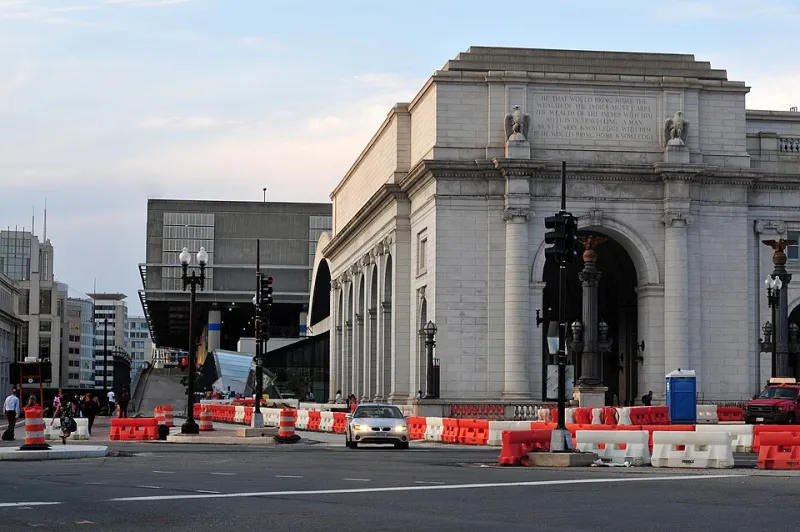
Finally, for those with a few extra minutes before their departure, the station's exterior forecourt offers a perspective that many visitors overlook entirely: a full view of Burnham's facade, with its triumphal arch entrance and classical detailing, that frames the building's relationship to the city it was designed to serve. Union Station was always meant to be approached slowly, with attention. The design rewards exactly that.