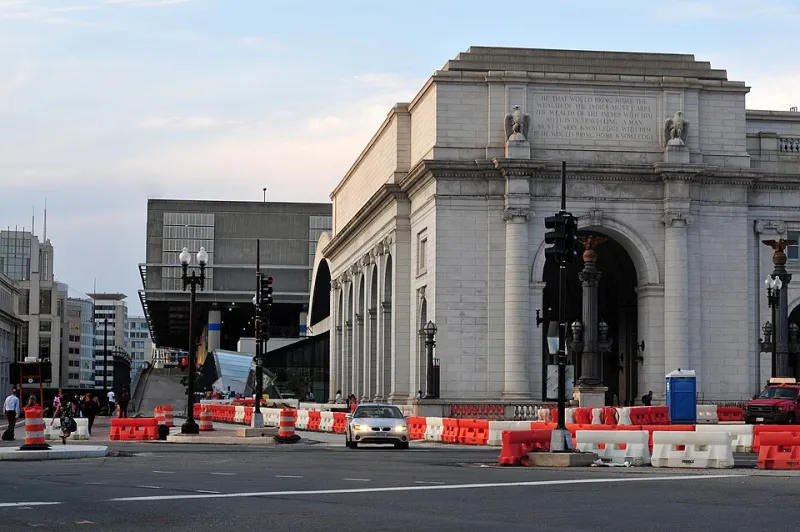
The Unwritten Station: Rituals, Rhythms, and the Private Life of America's Busiest Public Room
Union Station receives tens of millions of visitors each year. That figure, cited in tourism literature and transit reports, tends to flatten the reality of what actually occurs inside the building on any given weekday. Within that aggregate are the tourists arriving for the first time, luggage in tow, necks craned toward the vaulted ceiling. There are the Amtrak passengers running the clock against a departure. And then there are the others — the regulars, the commuters, the daily workers — who navigate the station with a practiced fluency that is almost invisible to the casual eye.
These are the people who know Union Station not as a landmark but as a place. Their relationship with the building is intimate in the way that only repetition can produce, and their accumulated knowledge of its rhythms, its personalities, and its unannounced customs constitutes an oral tradition that rarely makes it into any official account of the station's history.
The Morning Choreography
For those who commute through Union Station regularly, the building has a daily arc as predictable as a tide chart. The first hour after the main hall opens carries a particular quality: quieter, cooler, the light still low and angled, the food vendors beginning their preparation routines. Commuters who have learned this hour tend to guard it. The station at seven in the morning belongs to a different population than the station at noon.
Regular travelers often develop highly specific navigation habits — particular entrances preferred for their proximity to certain platforms, particular staircases favored because they deposit one closer to a specific corridor. These routes are rarely the most obvious ones and would not appear in any visitor guide. They are the product of accumulated small decisions made over months or years of daily passage.
The morning coffee ritual is its own institution. Certain vendors have served the same commuters for years, and the transactions that occur there carry a social weight that exceeds the exchange of currency for beverage. Names are known. Preferences are remembered without being stated. There is a kind of citizenship conferred by regularity, and the station's daily population maintains its own informal social hierarchy built almost entirely on the currency of familiarity.
Architectural Easter Eggs Along the Daily Route
One of the more remarkable features of Union Station is the degree to which its decorative program rewards sustained attention — and the degree to which most daily commuters pass that program without registering it. The main hall's barrel vault contains relief figures representing the nations of the world, installed when the station opened in 1907 and restored to varying degrees during the 1988 renovation. Most commuters have walked beneath these figures thousands of times without once looking up to identify them.
Similarly, the station's exterior stonework incorporates a series of carved figures along the facade representing progress, industry, and fire — the latter a pointed reference to the practical hazards of steam-powered rail travel at the turn of the century. Regular visitors to the building's exterior rarely pause to examine these figures, yet they constitute a narrative program that Burnham and his collaborators considered integral to the station's meaning.
For the traveler willing to arrive twenty minutes early and walk the perimeter of the main hall slowly, the building offers a kind of scavenger hunt that most guidebooks do not describe. The reward is not a prize but a revised relationship with a space one thought one already knew.
The Lunch Hour as Social Institution
Union Station's concourse level has, over the decades, developed into something considerably more complex than a transit food court. For the surrounding Capitol Hill community — staffers, lobbyists, journalists, and the vast support workforce that keeps the legislative apparatus functioning — the station's dining options represent a genuine neighborhood amenity rather than a convenience for travelers.
Regular lunch visitors have their established tables, their preferred vendors, and their unspoken protocols about which spaces are appropriate for working lunches versus informal conversation. The station's central location and its status as a public building make it a neutral meeting ground — a place where people from different professional contexts can encounter one another without the formality that a restaurant reservation implies.
This social function is not advertised, but it is real, and it shapes the character of the station's midday hours in ways that are perceptible to attentive visitors. The lunchtime crowd is more purposeful than the tourist crowd, its movements more directed, its noise more conversational than exclamatory. It is the sound of a community rather than an audience.
Platform Folklore and Departure Superstitions
Among frequent Amtrak travelers departing from Union Station, a small body of informal lore has accumulated around the experience of waiting for trains. Certain benches in the waiting area are considered preferable — positioned for early visibility of the departure boards, or simply because they have been occupied so many times by the same traveler that they have acquired a talismanic quality.
There are those who maintain personal rituals around departure: a particular sequence of tasks to complete before proceeding to the platform, a specific food or drink purchased from a specific vendor before a long journey. These habits are rarely shared publicly and would sound, in any formal description, merely like personal quirks. But they represent something more — an attempt to impose order and continuity on the inherently unpredictable experience of travel, and to claim some small portion of a vast public building as one's own.
What the Station Teaches Regular Visitors
The most consistent observation offered by those who spend significant time at Union Station is that the building changes — not physically, but perceptually. Spaces that seemed overwhelming on first encounter become navigable, then familiar, then legible in ways that are difficult to articulate. The station begins to communicate its own logic: why the main hall is positioned as it is, why the sight lines are arranged to draw the eye toward the train concourse, why the scale that initially intimidates eventually becomes reassuring.
This is, in a sense, what Burnham intended. The City Beautiful philosophy held that great civic architecture should educate as well as impress — that exposure to well-designed public space would gradually cultivate a public capable of appreciating and demanding it. Whether one accepts that proposition in full, Union Station offers reasonable evidence that architecture can, over time, become part of the texture of daily life rather than a backdrop to it.
For the visitor who arrives only once, the station is a monument. For those who return, it becomes something more difficult to name — a fixed point in a mobile life, a place that is both entirely public and, in some private sense, one's own.