Monument and Marketplace: Navigating the Dual Life of Union Station's Grand Interior
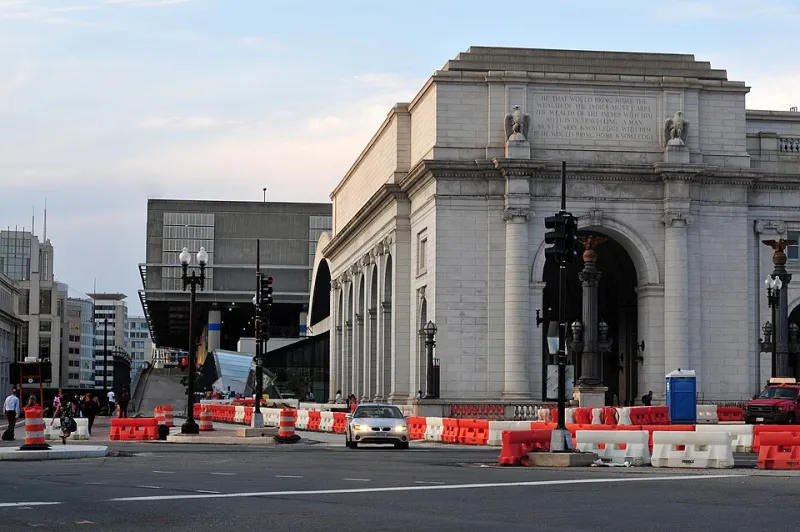
Photo: Ralf Roletschek (talk) - Infos über Fahrräder auf fahrradmonteur.de Wikis in der Ausbildung, CC BY-SA 3.0, via Wikimedia Commons
Not every great building gets to remain useful. Many of America's most celebrated architectural landmarks survive today as museums, preserved behind velvet ropes and admission fees, their original purposes long since dissolved. Union Station in Washington D.C. has taken a different path—and for the traveler willing to pay attention, that path reveals itself in the textures of a single afternoon spent wandering its halls.
The station is, depending on the hour and one's angle of approach, a transportation gateway, a dining destination, a shopping center, a film location, and a monument to the Beaux-Arts idealism of the early twentieth century. These identities do not always sit comfortably alongside one another. But the negotiation between them—ongoing, imperfect, and genuinely fascinating—is precisely what makes Union Station one of the most layered visitor experiences in the American capital.
Arriving With Context
The first thing a visitor should understand about Union Station is that its current form is itself a historical artifact. The building that opened in 1907 under the vision of architect Daniel Burnham was designed to be overwhelming—a civic threshold announcing that the nation's capital took seriously its role as a world-class city. The Main Hall, with its 96-foot barrel-vaulted ceiling, its 96 Roman legionnaire statues lining the upper arcade, and its sweeping Tennessee marble floors, was not incidental decoration. It was a deliberate argument about the dignity of public space.
That argument did not go uncontested. By the 1970s, the station had fallen into disrepair, and a failed conversion to a visitors' center left it in structural crisis. The 1988 reopening, which followed a complex public-private restoration effort, introduced the commercial programming that defines the station today. Shops, restaurants, and event spaces were integrated into the historic envelope—a practical necessity that funded the building's revival but also changed its character in ways that visitors continue to experience and interpret differently.
Knowing this history before you arrive means you can read the space more clearly: the tension between grandeur and commerce is not an accident. It is the condition of the building's survival.
The Main Hall: Where the Monument Speaks Loudest
Begin, as all visitors should, in the Main Hall. Stand at the center of the space, resist the pull of the retail storefronts lining the perimeter, and simply look up. The coffered ceiling, restored to its original dimensions and detailing during the 1980s rehabilitation, remains one of the most impressive interior volumes in Washington—a city not lacking for impressive interiors.
The statues along the upper arcade are worth seeking out individually. Each figure is rendered in a posture of composed authority, and their collective presence gives the hall a ceremonial weight that no amount of retail activity below can entirely dissipate. This is intentional. The architectural hierarchy of the space ensures that the historic structure commands attention even as contemporary commerce occupies its ground level.
Morning visits, particularly on weekdays before the midday rush, offer the closest approximation of the hall's original atmosphere. The light enters differently at that hour, and the relative quiet allows the architecture to assert itself more fully than it can during the afternoon crowds.
Commerce in a Historic Frame
The retail and dining offerings at Union Station are extensive, occupying the former waiting rooms, concourse spaces, and lower-level areas that once served purely utilitarian functions. For visitors primarily interested in the building's history, this commercial layer can initially feel like an interruption. With some adjustment of perspective, however, it becomes something more interesting: evidence of the ongoing negotiation between preservation and use that defines the station's contemporary life.
The food hall on the lower level, for instance, occupies spaces that were once part of the station's operational infrastructure. The architecture in these areas is less formally grand than the Main Hall above, but it retains the proportions and material quality of the original construction. Eating here, one sits within the building's working history rather than merely observing its ceremonial face—a different kind of engagement, but a genuine one.
The retail storefronts along the Main Hall perimeter have been designed to minimize visual intrusion on the historic fabric, with signage and fixtures held to standards that prevent the most aggressive commercial aesthetics from overwhelming the architectural context. The results are uneven—some tenants integrate more gracefully than others—but the overall effect preserves the primacy of the space itself.
Finding the Historic Seams
For visitors willing to move slowly and look carefully, Union Station offers a series of moments where the historic and contemporary layers of the building become visible simultaneously. The transition zones between the restored Main Hall and the more heavily commercialized concourse areas are particularly revealing: here, one can observe the different material palettes, lighting approaches, and spatial scales that mark the building's various periods of use and renovation.
The station's public art program adds another dimension to this layered experience. Works installed at various points in the building's post-restoration history engage with themes of travel, history, and civic identity, creating a dialogue between the contemporary and the historic that extends the building's interpretive range beyond its architecture alone.
The Amtrak concourse, while primarily functional, retains elements of the original station design that reward attention. The structural logic of the building remains legible here, and the experience of moving from the ceremonial grandeur of the Main Hall through the operational spaces to the train platforms enacts, in compressed form, the journey that millions of travelers have made through this building over more than a century.
Practical Guidance for the Intentional Visitor
A meaningful visit to Union Station benefits from a modest amount of planning. Allocate at least ninety minutes if your interest extends beyond transit—enough time to move through the Main Hall thoughtfully, explore the concourse areas, and spend some time in the lower level before the midday crowds arrive in force.
The station is open daily and admission to the public spaces is free. Guided tours, when available, provide historical context that enriches the experience considerably. If no tour is scheduled during your visit, the building's architectural details are sufficiently legible to reward self-directed exploration, particularly if you arrive already familiar with the station's history.
For dining, the options range from quick-service to sit-down restaurants, with quality varying accordingly. The building itself remains the primary attraction; the culinary offerings are best understood as an amenity rather than a destination in their own right.
A Space That Earns Its Complexity
Union Station will not offer every visitor the same experience, and that is perhaps the most honest thing that can be said about it. Those who arrive seeking a pure historic encounter will find moments of genuine architectural transcendence interrupted by the realities of a commercially active building. Those who arrive expecting only a convenient transit hub will find themselves confronted, repeatedly, by evidence of something far more ambitious.
The station's dual identity is not a problem to be resolved. It is the condition of a building that chose survival over purity—and in doing so, remained available to the millions of travelers who pass through its doors each year, each of them briefly inhabiting the intersection of American history and American daily life.